The ‘Burning of the Lakes Region 4’ project has been completed
Yapılış Tarihi | 28 August 2026, Friday

Contributions from Burdur continue for the 31st Conference of the Parties (COP) to be held in Antalya from November 9-20 under the United Nations Framework Convention on Climate Change.
Various activities are being carried out across Turkey ahead of the Conference of the Parties, which is an international summit where joint decisions are made to combat climate change. In line with the COP31 goals, academics from MAKÜ continue their projects and studies without slowing down. In this context, the 4th edition of the ‘Burning of the Lakes Region Project’, which was initiated for the first time in 2022 with the participation of 24 teachers from Burdur and surrounding provinces, has been realized.
With the project conducted under the leadership of Isparta Şehit Polis Mehmet Karacatilki Science and Art Center between August 24-28, 2026, it aims to draw attention to the drought experienced in the Lakes Region, water loss in lakes, changes in wetland ecosystems, biodiversity, and the effects of climate change on natural life.
The ‘Burning of the Lakes Region 4’ project, which is carried out with the participation of teachers from different provinces and branches, aims to protect the increasingly drying ecosystem of the Lakes Region and pass it on to future generations.
In the project led by Dr. Zuhal Küçükyaman on behalf of Isparta Şehit Polis Mehmet Karacatilki Science and Art Center, Dr. Lecturer Ahmet Koca from Isparta University of Applied Sciences and Dr. Lecturer Uğur Tozkoparan from Burdur Mehmet Akif Ersoy University served as experts.
In the project, which involved 24 teachers working in schools affiliated with the Ministry of National Education, many topics were addressed, from the water cycle to the protection of lake ecosystems, and from the effects of drought to the correct use of water resources.
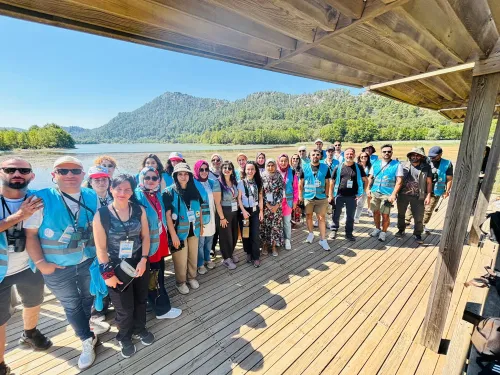
In the project, 1 coordinator, 2 experts, 30 trainers, 4 guides, and 1 health personnel were involved. Participating teachers had the opportunity to examine the reasons for the drying of the lakes in the Lakes Region and the effects of drought on agriculture, economy, and aquatic life through a total of 31 theoretical and practical activities.
Training and field studies were conducted at Burdur Lake and Salda Lake, Eğirdir Lake and Kovada Lake National Park, as well as Gölcük Lake Nature Park, Eğirdir Fisheries Research Institute, Mehmet Akif Ersoy University Greenova Vocational School, and Isparta University of Applied Sciences Biogas and Compost Research Laboratory.
Birds observed in their natural habitats
As part of the project, Dr. Lecturer Yasemin Özdemir, Director of the MAKÜ Wildlife Protection, Rehabilitation Practice and Research Center, participated in field studies conducted at Kovada Lake on August 26 and at Burdur Lake on August 27.
During the events where bird observations were also made, participants observed birds in their natural habitats using equipment such as binoculars and telescopes. Thus, the theoretical information provided within the project was supported by field studies.
Comparative observation in two different lakes
In the study conducted at Kovada Lake, the importance of different habitats around the lake for birds was addressed, while participants had the opportunity to examine the wetland ecosystem on-site.
In the study at Burdur Lake, the current ecological status of the lake and the effects of changes in water levels on wetland habitats were evaluated. During the observations, attention was drawn to the relationships between drought, habitat loss, biodiversity, and the protection of natural areas.
Through field studies conducted in two different wetlands, participants were enabled to evaluate the ecosystems in the Lakes Region comparatively.
Information from expert academics in the field
In the trainings conducted with the contributions of expert academics, topics such as the natural resource values of the Lakes Region, water ecosystems, biodiversity, the relationship between agriculture and water, tourism activities, sustainability, and water management were addressed from the perspectives of different disciplines.
Dr. Lecturer Yasemin Özdemir, Director of the MAKÜ Wildlife Protection, Rehabilitation Practice and Research Center, provided information to participants about the importance of wetlands in terms of biodiversity, the relationships of birds with these areas, and the possible effects of environmental changes in lakes on bird populations during field trainings.
Prof. Dr. Yıldırım Atayeter provided training on the natural features, geomorphological structure, and environmental values of Eğirdir Lake and Gölcük Lake Nature Park, while the natural formation features of İnsuyu Cave were also conveyed to the participants.
Prof. Dr. İskender Gülle shared information about the biological characteristics, aquatic ecosystem structure, and species diversity of Burdur Lake, while Prof. Dr. Deniz İnnal conducted training on the risks posed by invasive species in aquatic ecosystems and their effects on biodiversity.
Prof. Dr. Erol Kapluhan emphasized the importance of sustainable water management by addressing the relationship between water use, agricultural activities, and water resources.
Dr. Lecturer Onur Yayla made evaluations on the current status, ecological problems, and water loss process of Burdur Lake.
Dr. Lecturer Uğur Tozkoparan from Burdur Mehmet Akif Ersoy University made evaluations on the relationship between tourism activities, conservation status, and sustainable use of Salda Lake.
Assoc. Prof. Dr. Salih Soslu addressed the historical use of water in the ancient city of Sagalassos, ancient water systems, and the importance of water in the context of cultural heritage.
Assoc. Prof. Dr. Bekir Tosun also provided training in the field of dry farming practices.
With these trainings, it was aimed for participants to evaluate lakes not only as natural areas but also as ecosystems that carry multidimensional values in terms of agriculture, tourism, economic activities, cultural heritage, and local life.
Attention was drawn to the protection of lakes
With the “Burning of the Lakes Region 4” project, it is aimed to raise awareness about the effects of changes in lakes due to climate change, drought, and human-induced impacts on natural life and economic activities in the region.
One of the main objectives of the project was for the teachers participating in the trainings to pass on the knowledge and experiences they gained to their students. In this context, it was aimed for teachers to raise awareness among their students about the correct use of water, the decrease in aquatic life, sources of pollution, climate change, and individual measures that can be taken.
With the project, it is aimed for teachers to take on the role of environmental ambassadors and to develop awareness of water conservation and nature protection among students from a young age.
With the ‘Burning of the Lakes Region 4’ project, it is aimed to contribute to the raising of a conscious and sensitive generation for the protection of Turkey's water resources, especially in the Lakes Region.